

Honesty is considered a positive trait all over the world. And of course we all want to feel good. But how honest do you actually have to be to still feel good about yourself? This blog explores the relationship between honesty and wellbeing.
Golden Behaviors
– Nudges for a Healthy Lifestyle –
Reading time: 5 minutes
My own honesty was tested last month. Although I passed the test, I only did so narrowly. Here is what happened. My friend Niels sent me some books on psychology he thought I would be interested in. Since the outbreak of COVID-19, we don’t see each other in real life as much as we used to. Like many other people we mostly resort to communicating online. Because we both prefer the good old paper book over the E-book, Niels made a parcel to get me the books.
Getting my honesty tested
One week later I still hadn’t received the books. “Delivered at your house, four days ago.“, Niels told me after checking the track & trace. I had been home four days ago and I sure hadn’t received any parcel. When I called the courier to ask about the parcel, they promised to send over the deliveryman to my house. The next day the deliveryman came over, apologized about the missing parcel and offered to refund my loss. He asked me how much it would cost to buy a new set of books. I told him €50, which was a honest assessment. The deliveryman got €50 out of his pocket, gave it to me and said goodbye. No receipt, no signature asked, no nothing. Strange, but maybe that’s how they conduct business. Hassle free.
A couple of days later, my next-door neighbor came by my house and told me she had received a parcel for me the week before, just as she was about to go on a short holiday break. I opened the package and there were the books Niels had send me. Apparently the track & trace misrepresented it to be delivered at my place. Because of my neighbor’s holiday break, it took a while to clear up the misunderstanding. Now I had both the books and the €50. And here is where my honesty got really tested: do I benefit from the situation and keep the €50? Or do I want to be honest and feel good by returning the €50 to the rightful owner?
The science of honesty
If you were a rational human being like the field of economics assumes, you would visit the supermarket while thinking about robbing it. You would consider how much you would benefit from the robbery in terms of money, estimate the chances of getting caught, and evaluate how harsh the punishment would be. You would be making a perfect cost-benefit analyses as you walk down the aisles. Thankfully, that is not how most people go about their shopping habits.
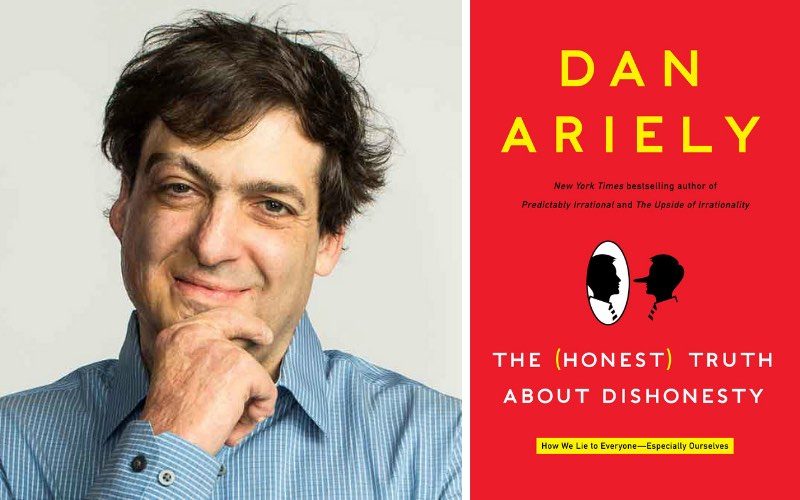
Professor of Psychology and Behavioral Economics Dan Ariely researched the topic of honesty extensively. He argues that it is helpful to think of people as having two fundamental motivations: The desire to see themselves as good, honest people and the desire to gain from the benefits that come from cheating. He conducted an experiment at Carnegie University to prove this.
In the experiment students were asked to solve up to 20 math problems as they could in 5 minutes. When time was up, they were asked to put their paper in the shredder and walk up to the researchers to get paid 1 dollar per math question solved. Since the papers were shredded first, the researchers could not check the actual math questions solved and gave the students an opportunity to cheat. On average they told the researchers to have solved 6 math problems. In the control group where there was no shredder and students had to hand in their work, they solved on average only 4 math problems. So there was definitely some cheating going on in the experimental group, but that wasn’t even the most surprising fact. It turned out that the cheating was not done by a few big cheaters, but by a lot of small cheaters who upgraded their performance just a little bit. That way they could benefit from their cheating, but still feel good about themselves. Maybe they even rationalized that the would have solved 6 math questions if they were better rested or tried harder.
Variations on the experiment showed that honesty can be increased or decreased in several ways. Cheating increased when one participant, who was a confederate of the researchers, called out after only one minute that he had solved all 20 math questions. The rest of the group was still at question number 1 after one minute, so they knew it couldn’t be true. This negative social norm triggered the rest of the group to cheat more, since they knew other people were doing it as well.
Cheating decreased when the confederate, who said that he had solved all the questions after 1 minute, was wearing a jersey from a competing university. The resulting ingroup – outgroup effect, had a positive influence on the rest of the group. They didn’t want to be like the cheater from the competing university and it decreased cheating.
Honesty and wellbeing
When both the books and the €50 from the courier were in my possession, I had my two fundamental motivations at work. On the one hand I wanted to consider myself a good, honest person and return the €50. On the other hand I had the desire to benefit by cheating and keep the €50.
What made a significant impact on my decision to return the €50, was the fact that I felt it came out of the courier’s own pocket. Since I didn’t get a receipt or signed anything, I thought that it might be a subcontractor who wanted to handle the situation without causing a problem with his client. I didn’t want to take money from a small business owner working hard to provide for his family. It would have negatively influenced my wellbeing. So I contacted the deliveryman, told him I had finally received the parcel and returned the €50.
I also realized I may have been more ‘flexible’ in my honesty if I knew it to be the money of a large and rich corporation. I probably could have rationalized my dishonesty by viewing the €50 as a offset for my inconvenience. The recipient of any dishonesty on my part played an important role in my decision to either return or keep the €50.
Around the world
When tested on the matter, most people turn out to be pretty honest. The ‘math problems’ experiment was conducted around the world with the same results coming up everywhere. We cheat, but mostly not by any significant amount. And the good news is that even that behavior can be positively influenced by nudging. If you want to know how to increase honesty in your organization, feel free to contact me.
How Honest Do You Have to Be to Feel Good? Delen op X
Sander Palm (1980) is author of Golden Behaviors and behavioral economist. He uses insights from the behavioral sciences to explain why people often act against their own interests. As a behavioral expert, he explores how you can nudge your behavior for a healthy lifestyle. He has a Master of Science in Marketing (VU University Amsterdam).
When you have been inspired to start and maintain your Golden Behaviors, reach out to me
Source of top image: Photo by Ekaterina Bolovtsova via Pexels
No responses yet